
Don’t Wait! Check Your Home’s Pipes with Whole House Plumbing Inspection and Leak Detection Price in Johannesburg, Roodepoort, Sandton, Randburg, Eastrand, Midrand, Centurion & Pretoria
Looking for a clear local guide to Whole House Plumbing Inspection and Leak Detection Price in Johannesburg? We created this page as a practical pricing guide for homeowners who want transparent totals before booking.

We explain how on-site scope changes the final bill: a quick confirmation is cheaper than full-zone checks, and detection-only work differs from a combined detect-and-repair visit.
Typical ranges in Johannesburg: standard visits often fall between R1,200–R3,500, while detection-only budgeting can run R850–R5,000+ depending on access and tech used.
Who this is for: high water bills, damp or mould, meter creep, or sudden pressure drops. We start with non-invasive methods to protect finishes and keep costs down.
Our promise: we locate, confirm and mark the fault area, then separate detection from repair so your budgeting stays simple and predictable – Contact Us
Whole house leak detection and plumbing inspections in Johannesburg: what we do and when you need it – Whole House Plumbing Inspection and Leak Detection Price
We begin by confirming the symptom, then isolate sections, test, and pinpoint the source with the least disruption possible. Our approach uses non-invasive checks first. That keeps reinstatement costs lower and speeds up next steps.

Common warning signs
- Rising water bills or sudden bill spikes
- Musty smells, visible mould, peeling paint or damp patches
- Meter creep: the metre moves when all taps are off
DIY pre-check
| Action | What to note | Why it helps |
|---|---|---|
| Turn off appliances | Ensure no one uses taps | Confirms unseen flow |
| Check metre | Record reading after 15 minutes | Detects persistent flow |
| Note damp areas | Skirting, ceilings, garden spots | Guides targeted checks |
Hidden zones we check
We inspect walls, floors, ceilings, garden lines, pool plumbing and under-slab routes. Each zone shows different signs—damp skirting often points to a wall cavity pipe, while soggy turf suggests an external supply fault.
| Symptom | Likely source | Expectation |
|---|---|---|
| Damp skirting | Wall cavity pipe | Non-invasive trace first |
| Soggy patch in garden | Supply line | Acoustic or tracer gas |
| Pool level drop | Pool plumbing | Pressure test then locate |
Why act early in South Africa? High pressures and water scarcity make swift action vital. Early work saves litres, limits structural water damage and reduces costly mould remediation later.
Book us today if you see rapid bill spikes, hear running water with taps off, notice spreading damp, need repeated pool top-ups, or your insurer requests trace documentation.
Whole House Plumbing Inspection and Leak Detection Price in Johannesburg: current ranges and what they typically include
Below are the realistic cost ranges Johannesburg homeowners should budget for today.
Standard jobs generally fall between R1,200–R3,500 for a typical visit. For detection-only work expect R850–R5,000+ depending on access and complexity. We quote repairs, access cutting and reinstatement separately unless stated.

Inclusions versus common exclusions
We include call-out, systematic checks, non-invasive testing where suitable, marking and a short report. Anything that exposes or fixes the pipework is usually extra.
| Included in detection | Usually quoted separately | Why separate |
|---|---|---|
| Call-out and attendance | Repair labour & materials | Repairs vary by part and time |
| Non-invasive tests (acoustic/thermal) | Access cutting (tiles/concrete) | Demolition & safety risks |
| Marking suspected area | Reinstatement (tiling/paint) | Trades and finishing costs |
Pricing models we use
We offer flat totals for standard homes (often R800–R1,400 for a basic assessment) or per-square-metre rates (roughly R70–R100/m²) for larger properties or estates.
| Property size / complexity | Best model | Expectation |
|---|---|---|
| Small / single-storey | Flat total | Predictable, lower admin |
| Large / multi-zone | Per m² or scoped quote | Fairer for large areas |
| High finishes / hard access | Scoped quote | Includes risk items |
- How to keep costs low: tell us symptoms, give access to meter/stopcock/geyser, and book scheduled slots rather than emergencies.
- FAQ: Does the leak detection price include the repair? No—repairs are usually a separate scope and cost.
Call-out fees, hourly rates, and after-hours pricing we use to build transparent quotes – Whole House Plumbing Inspection and Leak Detection Price
We list the common call-out ranges, hourly rates and after-hours multipliers so you can budget accurately.
Call-out fees typically range from R450–R750. This fee covers travel, on-site assessment and an initial allocation of time for basic checks and testing.
Hourly labour in South Africa normally sits between R600–R850/hour, though some work can fall as low as R400/hour or exceed R900/hour depending on complexity and specialist skill required.

Why emergency times cost more
Emergency attendance carries extra costs for mobilisation, staffing and urgency. Expect added emergency fees of roughly R600–R1,300+ and labour multipliers of 1.5×–2× for evenings, weekends or public holidays.
How we build a quote
| Component | Typical range | What it covers |
|---|---|---|
| Call-out fee | R450–R750 | Travel, basic assessment, initial time |
| Labour (per hour) | R400–R900+ | Time on site for tracing or repairs (excl. materials) |
| Emergency uplift | R600–R1,300+ | Mobilisation and out-of-hours attendance |
| Reporting & minor equipment | R0–R500 | Marked location, short report |
Worked examples
| Scenario | Call-out | Labour (2 hrs) | Emergency fee | Estimated total |
|---|---|---|---|---|
| Scheduled weekday visit | R550 | R1,400 (R700/hr) | R0 | R1,950 |
| Weekend emergency | R650 | R1,400 (R700/hr) | R900 | R2,950 |
| After-hours long job (4 hrs) | R650 | R3,360 (R840/hr ×1.5) | R1,000 | R5,010 |
Quick checklist to avoid emergency fees
- Book a scheduled call as soon as you spot meter creep.
- Turn off the stopcock where safe to do so.
- Isolate the geyser if it is clearly involved and you know how.
Our promise: we explain all fees before any work begins and keep detection and repair quoted separately unless you request a combined service.
Leak detection methods we use (non-invasive first) and how each method affects the price – Whole House Plumbing Inspection and Leak Detection Price
We favour non-invasive methods first. This saves finishes and usually lowers the overall cost.
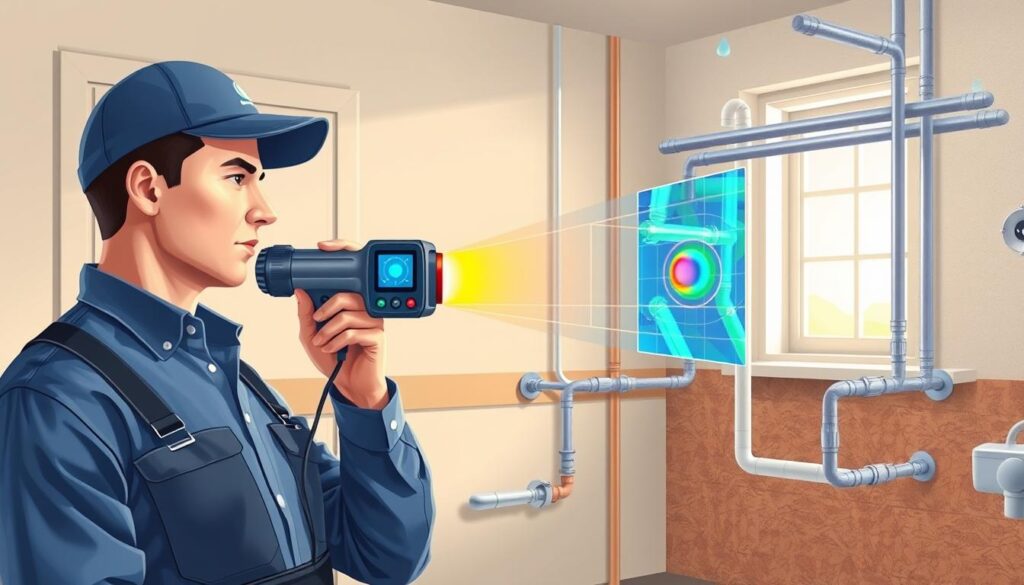
Acoustic detection listens for pipe noise through surfaces. It works well on pressurised supply lines and underfloor runs. Typical cost: R850–R2,500.
Thermal imaging uses infrared to show temperature and moisture differences. It is best for hot-water lines, ceilings and wall cavities. Typical cost: R1,500–R3,500.
Tracer gas is a high-precision option for hard-to-find faults. We introduce a safe, non-toxic mix into a drained run and trace where it escapes. Typical cost: R2,000–R4,500.
Method selection
| Symptom | Location | Best method |
|---|---|---|
| Running meter | Internal walls | Acoustic |
| Cold patching | Ceiling/roof | Thermal imaging |
| Soggy turf | Buried pipe | Tracer gas |
Technology comparison
| Method | Accuracy | Disruption | Typical time on site |
|---|---|---|---|
| Acoustic | Good | Low | 30–90 mins |
| Thermal imaging | Good | Low | 45–120 mins |
| Tracer gas | Very high | Low–Medium | 60–180 mins |
We often combine methods to confirm results. If we do, we explain how this alters the final cost before work begins.
- What you receive: marked location, short notes on methods used, and clear next-step repair options.
What drives the final cost on your home: the practical factors we assess on-site – Whole House Plumbing Inspection and Leak Detection Price
When we arrive we focus on two simple drivers: time on site and the tools the job needs. That gives a quick, honest view of likely cost so we do not guess or upsell.

Property size and complexity
More bathrooms, long pipe runs, outbuildings or irrigation lines mean more zones to test. Greater property size raises the time required and therefore the cost.
Location and access
A leak behind an accessible ceiling hatch is quicker to confirm than one under tiles or under a concrete slab. Poor access often doubles the time and can change the method we choose.
Multiple sources and material type
Several moisture sources can mean layered problems — supply plus waste or condensation. Metal piping often works well with acoustic gear; some plastics need tracer gas or imaging to confirm.
Timing and urgency
Scheduled visits keep totals predictable. Same-day or after-hours work adds rates for mobilisation and staffing and typically increases the final cost.
| What increases cost | What reduces cost | How to keep totals predictable |
|---|---|---|
| Poor access, deep slabs, multiple zones, emergency call-outs | Clear symptoms, easy access points, single-zone problems, scheduled slots | Show meter/stopcock, clear geyser area, identify ceiling hatches before we arrive |
| What to prepare before we arrive | Why it helps | |
| Meter access and stopcock visible | We confirm flow quickly and avoid searching | |
| Geyser area cleared | Saves set-up time | |
| Ceiling access points identified | Reduces invasive work and time |
In short: we assess property size, access, number of leaks, material type and timing. That assessment sets the final cost so you can plan with confidence.
Johannesburg & suburbs pricing guide: what to expect across Gauteng hotspots – Whole House Plumbing Inspection and Leak Detection Price
Pricing shifts across suburbs often come down to access, traffic and the level of finishes we must protect. We set realistic expectations so you can budget before we visit.

Johannesburg and Sandton
Central areas frequently carry premiums due to restricted access, traffic delays and dense pipe networks in multi-storey buildings.
High-end finishes mean we use non-invasive methods and extra care, which can nudge standard prices toward the upper band.
Midrand and the East Rand
Travel time and outer-suburb call-outs are the usual drivers here. We often apply predictable travel fees or a per-kilometre approach.
Booking a morning slot helps us group visits and keep your cost down.
Roodepoort and Randburg
Common scenarios are garden supply runs, ageing internal lines and geyser feeds. These jobs often fit into a 1–3 hour inspection window.
We state up front if specialist tools are needed so the final cost is never a surprise.
Regional comparison
| Area | Residential range | Call-out expectation |
|---|---|---|
| Johannesburg / Sandton | R1,500–R3,500 | Higher due to access & finishes |
| Midrand / East Rand | R1,200–R2,800 | Travel charges possible |
| Roodepoort / Randburg | R1,200–R3,000 | Garden & geyser runs common |
| Outer Gauteng | R1,000–R3,200 | Variable by distance |
| Best booking times to reduce premiums | Why it helps | Expected fee impact |
| Weekday daytime | Predictable schedule | Lowest |
| Late afternoon | Less traffic but limited slots | Small uplift |
| After-hours / weekends | Urgency & mobilisation | Higher |
We quote transparently. Whether your job sits in a standard band or needs tracer gas, we explain any extra fee before work begins.
- Tell us these 3 details for a fast estimate: suburb, main symptom, and whether the fault is under slab, in a wall or in a pool.
Time on site and what happens during a whole house plumbing inspection and leak detection visit – Whole House Plumbing Inspection and Leak Detection Price
A typical visit follows a clear timetable so you know what we do and how long each step takes. We keep sentences short and our process visible so you can plan time around the work.

Our step-by-step workflow
- Isolate — shut supply sections to confirm the symptom.
- Test — pressure and flow checks with acoustic tools.
- Confirm — use thermal or tracer methods where needed.
- Mark — clearly mark the site for repair.
- Document — short report, photos and notes.
Typical durations by complexity
Easy jobs usually take 1–2 hours. Complex tracing can run 3–5+ hours when under-slab runs or multiple symptoms are present.
Access we may need
We ask you to show the water metre, stopcock, geyser area and any ceiling hatches. Clear out cupboards, secure pets and allow access to outbuildings if present.
| Task | Est. minutes | Likely equipment |
|---|---|---|
| Initial checks | 15–30 | Meters, pressure gauge |
| Acoustic scan | 30–90 | Acoustic probe |
| Thermal / tracer | 45–180 | Camera, tracer gas kit |
| What we document for you | Delivered | |
| Marked points | On-site marks | |
| Photos | Digital images | |
| Method notes | Which detection methods used |
To speed the visit: clear access, point out damp areas, and share previous repair notes. We protect finishes, confirm twice before cutting and keep disruption to a minimum.
Reports, insurance claims, and documentation: what we provide for trace-and-access support – Whole House Plumbing Inspection and Leak Detection Price
A good report transforms on-site findings into a usable claim pack for your broker or insurer. We focus on clear evidence that helps you decide the next steps and speeds any insurer response.
What insurers often ask for
Insurers commonly request photographic proof, clearly marked locations, and concise method notes. We record which detection tools we used, such as acoustic or thermal methods, and add a short narrative of how we confirmed the fault.
Detection versus repair: scope clarity
We keep detection separate from repair. Detection locates and confirms the fault. Repair fixes the pipe and restores function. Reinstatement restores finishes like tiles or paint. Separating these scopes helps with budgeting and insurance claims.
Report options and typical add-ons
| Report type | Includes | When it’s worth it |
|---|---|---|
| Basic notes | Marked point, short method note, two photos | Small non-structural incidents |
| Insurance-grade | Multiple photos, timestamped method notes, diagram, signed summary | When submitting insurance claims or for extensive water damage |
| Full trace pack | All evidence, measured depth/position, suggested repair options | Complex sites, under-slab faults or disputed claims |
How to use the report: send the insurance-grade pack or trace pack to your broker, include the summary sentence that describes where the leak started and which method confirmed it. Keep a copy for maintenance records.
| Handover item | Delivered |
|---|---|
| Marked points | On-site marks and coordinates |
| Photos | Timestamped images showing wet areas |
| Summary notes | Method used and confirmation steps |
| Next steps | Recommended repairs and reinstatement options |
Why this matters: clear documentation reduces total damage by enabling quicker, targeted repairs. It removes guesswork for insurers and helps you approve repairs without surprise costs.
We keep scopes clear on purpose. That keeps budgeting honest and makes approving the next step straightforward.
Whole House Plumbing Inspection and Leak Detection Price: Conclusion
The best outcome: locate the fault precisely, avoid unnecessary cutting, and limit follow-on repair costs.
Key takeaway: the right approach finds the source with minimal disruption so you avoid larger repairs and further water damage. In Johannesburg typical jobs sit around R1,200–R3,500; complex cases R2,000–R5,000+ and after-hours or emergency attendance raises the final cost. Detection and repairs are usually quoted separately for clarity.
| Method | Time | Likely total |
|---|---|---|
| Acoustic | 30–90 mins | R850–R2,500 |
| Thermal imaging | 45–120 mins | R1,500–R3,500 |
| Tracer gas | 60–180 mins | R2,000–R4,500 |
Act early: quick checks cut damage to walls, floors, ceilings, gardens and pool lines. We move you from detect → mark → document → suggest repairs with clear costs before we start.
If you smell gas, switch off appliances, ventilate, and call certified gas support immediately—safety comes first.
Contact us with your suburb, symptoms and access notes so we can book the right slot and bring the correct equipment first time. We’re here to help you protect your home and keep costs predictable.
FAQ – Whole House Plumbing Inspection and Leak Detection Price
What areas do we cover for full plumbing inspection and leak detection in Johannesburg?
We operate across Johannesburg and all its suburbs, including Sandton, Randburg, Midrand, Roodepoort and the East Rand. Our teams travel throughout Gauteng, and call-out fees reflect distance and access complexity to keep quotes transparent.
What are the most common warning signs that we look for?
We watch for rising water bills, damp patches, visible mould, warm spots, and meter creep when all fixtures are off. These clues help us decide which non-invasive method to start with, such as acoustic testing or thermal imaging.
Which hidden locations do we routinely check for leaks?
We inspect walls, floors, ceiling cavities, gardens, pools and under concrete slabs. Each location guides the detection method — tracer gas for buried lines, thermal cameras for concealed hot water leaks, and acoustic gear for pressurised pipework.
How much does a standard detection visit in Johannesburg typically cost?
Standard detection-only jobs in Johannesburg commonly range from about R850 to R5,000+, depending on method and complexity. Typical end-to-end services for standard issues often fall between R1,200 and R3,500 and can include on-site testing and basic reporting.
What does a detection fee usually include versus what’s quoted separately?
Detection fees generally cover site assessment, testing with appropriate equipment, marking the fault and a basic report. Repairs, access work (breaking tiles or concrete), and reinstatement are usually quoted separately so customers can budget repairs independently from tracing.
How do we structure call-out and labour charges?
We use a clear model: a call-out fee to cover travel and initial assessment, plus hourly labour rates for technicians. After-hours or emergency visits attract multipliers. This keeps quotes transparent and helps clients compare scheduled visits against emergency responses.
What are typical hourly labour rates and emergency multipliers in South Africa?
Hourly labour varies by experience and region; typical plumber technician rates used in our quotes reflect local market levels. Emergency or after-hours work is priced higher — often 1.5x to 2x standard rates for evenings, weekends and public holidays.
Which non-invasive methods do we prefer and why?
We prioritise non-invasive techniques first: acoustic listening, thermal imaging and tracer gas where suitable. These limit disruption and often locate faults quickly. We escalate to invasive methods only when absolutely necessary for an accurate fix.
When is acoustic detection the best option and what does it cost?
Acoustic detection is ideal for pressurised cold-water supply lines and internal pipe runs. It’s effective where noise transmits through pipework and common price ranges for this method are around R850 to R2,500 depending on time on site and access.
When should we use thermal imaging and what should clients expect to pay?
Thermal imaging suits hot-water leaks, underfloor heating faults and wet areas behind finishes. Typical costs are R1,500 to R3,500; the method is fast, non-invasive and gives clear visual evidence for reports and insurance claims.
What is tracer gas detection and when is it necessary?
Tracer gas is used for buried or concealed joints and where other methods fail. We introduce an inert gas and use highly sensitive detectors to pinpoint escape points. Typical ranges are R2,000 to R4,500 due to equipment and setup required.
How do property size and plumbing complexity affect the final cost?
Larger properties and multi-zone plumbing take more time to test, increasing labour and possibly requiring multiple methods. Complex routing, additional meters or split systems all add to the on-site work and the final quote.
How does access and location of the fault influence pricing?
Faults hidden in ceilings, under tiles or beneath concrete slabs usually take longer to locate and may need specialist equipment, raising costs. Easy-to-access walls or exposed runs are quicker and typically cheaper to diagnose.
Do multiple leaks increase cost significantly?
Yes. Each distinct source can require separate tests and more time. We price to reflect the number of leak points and the cumulative investigative work needed to produce reliable findings and documentation.
What role do pipe materials and routing play in choosing a detection method?
Metal, PVC, PEX and older materials transmit sound and heat differently, which affects method choice. Metal may conduct acoustic signals well, plastic may suit thermal imaging, and complex buried routes can require tracer gas — all of which influence costs.
How quickly can we attend for a suspected leak emergency?
We offer scheduled bookings and same-day emergency responses where possible. Emergency visits incur higher fees but reduce water loss and potential damage. We’ll confirm availability and likely times when you call.
Are there regional price differences across Johannesburg suburbs?
Yes. Areas such as Sandton often carry premiums due to access and finish levels, while Midrand, the East Rand and Roodepoort may show different travel or labour factors. We reflect these variables in our transparent quotes.
How long does a typical inspection and detection visit take?
Simple checks usually take 1–2 hours. Complex tracing, multi-method investigations or slab work can take 3–5+ hours. We estimate duration on booking and confirm when onsite to manage expectations.
What access do we normally need from homeowners?
We typically need meter and stopcock access, geyser/boiler areas, ceiling or loft hatch access, and permission to move small items. For tiled floors or slabs, client discussion is required before any invasive access is attempted.
What documentation do we provide for insurers?
We supply photo evidence, marked locations, method notes and a written report. Insurance-grade documentation options are available as add-ons if your claim requires detailed technical notes and timestamps.
Do we separate detection and repair for insurance and budgeting clarity?
Yes. We provide clear separate scopes: detection and reporting first, then a repair proposal if required. This separation helps insurers assess liability and clients manage repair budgets without confusion.
How can we help keep detection costs predictable?
Book a scheduled inspection rather than emergency attendances, provide clear access, and share any prior reports or symptoms. Early intervention also reduces time on site and prevents escalation into more expensive repairs.