
Fence Welding Cost Explained: Get Affordable, Reliable Service in Johannesburg, Roodepoort, Sandton, Randburg, Eastrand, Midrand, Centurion & Pretoria
When considering Fence Welding Cost, are you sure you know what a fair quote looks like for metal repairs or a new boundary build in Joburg?
We introduce this practical guide for South Africa homeowners and small businesses who want clear, usable figures today.
Hourly rates commonly run from R250 to R700 depending on complexity, location and whether work is in-shop or on-site.
Prices can vary because the task ranges from a quick repair to full fabrication and installation. We price projects on scope, materials, access and safety, and accurate quotes often need a site visit.

Throughout this article we show hourly guides, per-metre ranges, repair versus replacement decisions, gate integration and how finishes affect total spend.
We aim to help you compare like-for-like quotes, understand line items and focus on long-term value rather than chasing the cheapest option – Contact Us
Fence Welding Cost in Johannesburg: current price ranges and what you should budget for
We outline the current price bands and sensible budgets for metal repairs and new boundary work across Johannesburg.
Typical hourly rates
Skilled trades usually charge between R250–R700 per hour. In-shop work tends to sit around R250–R350 per hour, while on-site visits commonly run near R350–R450 per hour because travel and setup add time and supplies.

Per-metre and project ranges
Simple per-metre work often falls between R300–R600 per metre. Complex or high-security work can push well above R1,000 per metre.
| Pricing model | Typical range | What is usually included |
|---|---|---|
| Per hour | R250–R700 | Labour, basic consumables |
| In-shop | R250–R350 | Controlled environment, lower travel |
| On-site | R350–R450 | Setup, travel, time on site |
Common add-ons
- Cutting out old sections and post re-setting
- Fabricating brackets, extra reinforcement
- Grinding, rust treatment, primers and paint
Budget advice: base your estimate on a labour allowance plus a contingency for hidden damage or awkward access. Ask each quote what is included so you compare scope first, price second.
Fence welding services we provide and how scope affects costs – Fence Welding Cost
We offer a full range of services across Johannesburg to help you choose the right project scope. Our aim is to balance immediate spend with long-term value.
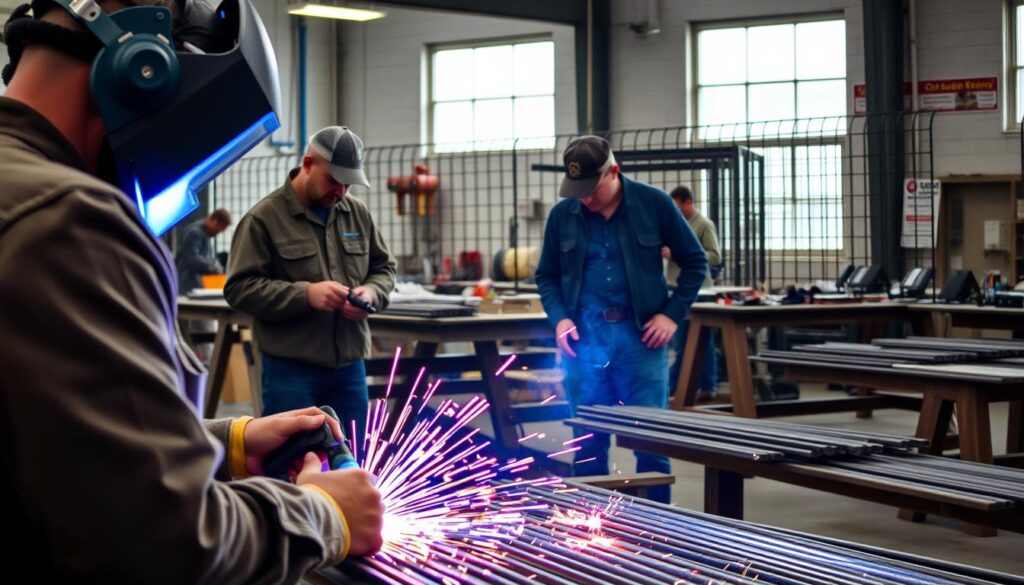
New sections and metal installation
For new sections we fabricate in workshop and finish on-site. Fabrication time, post alignment and on-site fitment add labour hours.
Installation is affected by access, material thickness and the need to re-square existing posts.
Repair versus replacement of panels, posts and rails
We assess structural soundness before recommending repair or replacement.
Repair often needs prep: cutting out rust, grinding to clean metal and re-squaring. That prep drives the actual price.
Gate welding and integration
Gates are usually the most complex projects. Precise hinge alignment, swing clearance and latch setup matter.
“A well-aligned gate reduces repeat repairs and protects long-term value.”
| Trigger | Repair likely | Replace likely |
|---|---|---|
| Surface rust, local cracks | Yes — prep and patch | No |
| Bent or hollow posts | No | Yes — post replacement |
| Misaligned or warped gates | Possible hinge reset | Yes — full gate rebuild |
To quote accurately we need photos, length in metres, material type, thickness, suburb, access and urgency. We use that info to give fair, comparable estimates.
Materials and metal types that influence welding prices – Fence Welding Cost
Material selection shapes labour, prep and the specialist techniques we need on site. Our choices change how long jobs take, which consumables we use and the risk of future repairs.

Steel: availability and key cost drivers
Steel is common in Johannesburg because it is strong, easy to repair and widely available. Thickness, number of joints and surface corrosion all increase time and prices.
Aluminium and stainless metal types
Aluminium and stainless steel need more control and cleaner prep. Many trades add a surcharge — often around 25% — because heat control and specialist rods reduce distortion and cracking.
Mesh, palisade and mixed designs
Welded mesh and palisade systems look simple but use many connection points. That raises labour even when material rates seem low.
Mixed-material designs can cause galvanic corrosion if details are wrong. Good design avoids mismatched thicknesses and incompatible fixings.
| Material | Welding difficulty | Surcharge / Time impact |
|---|---|---|
| Steel | Low–Medium | No surcharge; time rises with corrosion |
| Aluminium | High | Approx. +25% / longer prep |
| Stainless steel | High | Approx. +25% / specialised technique |
| Finish option | Upfront cost | Maintenance need |
| Galvanised | Moderate | Low |
| Paint (primer + topcoat) | Low–Moderate | Medium |
| Powder-coat | Higher | Low |
Our final recommendation: invest in the right material and finish now to avoid higher repair bills later. Cheaper choices can become more expensive through repeat work and corrosion at joints.
Key factors that affect the final fence welding quote – Fence Welding Cost
Small design details or awkward access often explain big differences between two similar quotes. We list the factors you should watch so quotes are comparable and fair.

Project complexity, design requirements and site conditions
Decorative elements, tight tolerances, security spikes and reinforcement all raise complexity. These items increase labour time and specialist technique needs.
Labour time, equipment setup and access constraints
Time on site includes measuring, clamping, cutting, grinding and safe positioning. Moving and configuring equipment adds to the quoted hours.
Travel, location and call-out fees across Johannesburg suburbs
Long trips, traffic and limited parking push on-site charges higher than in-shop rates. On-site work commonly sits nearer R450 per hour while very complex jobs can approach R700 per hour.
Safety, compliance and quality controls
Correct procedures, PPE, controlled heat input and checks safeguard long-term quality. We prioritise practices that prevent cracking and premature corrosion.
Repair urgency, emergency jobs and after-hours rates
Urgent jobs disrupt schedules and often attract a premium. Expect higher fees for rapid mobilisation or after-hours service.
“Transparent line items show why two quotes with the same length can still differ a lot.”
| Adjuster | Low impact | Medium impact | High impact |
|---|---|---|---|
| Access difficulty | Easy driveway | Tight parking | Complex apartment access |
| Corrosion / repair severity | Surface rust | Local replacement | Extensive decay |
| Working height | Ground level | Scaffold or ladder | Crane or specialist kit |
| Scheduling | Standard booking | Short notice | Emergency / after-hours |
Johannesburg suburbs and location-based pricing expectations – Fence Welding Cost
A clear site visit removes surprises: location, access and mobilisation usually determine the final estimate.
We set practical expectations for how pricing can shift across Johannesburg suburbs. Distance and traffic windows change travel time and scheduling. Security gates, parking and unloading also affect the time we need on site.

How travel time and logistics can shift rates
Why it matters: longer drives increase call-out hours and may force a minimum booking.
- Distance and peak traffic raise travel time.
- Restricted access (estates or commercial sites) needs permits or escorts.
- Heavy kit or awkward unloading adds labour and delays.
What we check during a site visit to price accurately
On site we measure length, confirm material and check rust, post stability and any need to straighten sections.
We note underground services, boundary clarity and urgent weak points so the quoted projects reflect true expenses.
| Travel band | Typical call-out | Scheduling |
|---|---|---|
| Near | Small fee; short minimum hours | Flexible |
| Medium | Moderate call-out; 2–3 hour minimum | Standard slots |
| Far | Higher call-out; longer minimum | Pre-booked only |
Checklist to prepare: photos, clear access notes, confirmed boundary lines and any site restrictions. Budget for travel as a normal line item to avoid surprises.
Cost breakdown tables and example budgets for fence welding projects – Fence Welding Cost
To help you compare quotes, we provide clear tables with hourly and per-metre ranges plus sample budgets.
Use these benchmarks to check whether a quote covers labour, materials, finish and travel or only a basic repair.

Hourly rates guide
| Setting | Typical range (per hour) | What drives higher charges |
|---|---|---|
| In-shop | R250–R350 per hour | Controlled environment; lower travel |
| On-site standard | R350–R450 per hour | Setup, travel, power management |
| Complex / urgent | R450–R700 per hour | After-hours, access, specialist equipment |
Per-metre ranges by type and scope
| Type & scope | Repair (per metre) | Fabrication + installation |
|---|---|---|
| Welded mesh-style repairs | R300–R600 | R400–R1,000+ |
| Palisade / security sections | R400–R900 | R800–R5,000+ |
| Mixed steel / heavy fabrication | R600–R1,200 | R1,000–R10,000+ |
Gate work and repair ranges
| Scope | Typical range | Common inclusions |
|---|---|---|
| Small repair (hinges, latch) | R500–R2,000 | Labour, basic parts, adjustments |
| Re-hang / reinforce | R2,000–R7,000 | New brackets, post reinforcement |
| New gate / full rebuild | R7,000–R20,000+ | Supply, frame, installation, finish |
Quote checklist — compare like-for-like
| Line item | Include? | Notes |
|---|---|---|
| Labour hours | Yes | State hourly rate and estimate of hours |
| Materials & specification | Yes | Thickness, grade and finish listed |
| Cutting / grinding / prep | Yes | Surface repair vs replacement |
| Finishing (primer/topcoat) | Yes | Quoted separately or included |
| Travel / call-out fees | Yes | Distance band and minimum hours |
| Removal & disposal | Yes | If replacing panels or posts |
| Warranty / checks | Yes | Period and scope of guarantee |
Common add-ons and their impact
| Add-on | Impact | Notes |
|---|---|---|
| Rust cut-out & patch | Medium | Increases prep time |
| Galvanising / powder-coat | High | Better longevity; higher upfront fees |
| Post replacement | High | Material + excavation adds expense |
Example budgets
- Small repair: R500–R2,000 — labour, hinge/latch parts, basic paint.
- Medium reinforcement: R4,000–R12,000 — several hours, materials, travel and finish.
- Larger section + gate: R10,000–R40,000+ — fabrication, installation, gate supply and finish.
How to use this: match each quote line item to the checklist. That way you avoid comparing a cheap, welding-only price against a full supply, installation and warranty offer.
Fence Welding Cost: Conclusion
Here we summarise practical steps to turn prices into predictable, long‑lasting results.
Prices in Johannesburg depend on scope, material, access, travel and safety controls. The right price matches a clear scope with quality prep, finish and warranty that protect long‑term value.
Use the tables above to sanity‑check hourly and per‑metre ranges and common add‑ons before you request quotes.
To quote fast and accurately we need: photos, approximate metres, material type, suburb, access notes and urgency. Ask each service for a line‑by‑line quote showing travel, consumables and finishing.
Next steps: arrange a site visit where needed, confirm inclusions and exclusions, and choose the option that balances upfront price with durability and fewer repeat repairs.
FAQ – Fence Welding Cost
What are the typical hourly rates we can expect for welding fence work in Johannesburg?
Hourly rates vary by skill level and location. For general metalwork we typically see technicians charging between R250–R700 per hour. Tradespeople offering mobile on-site service often charge toward the higher end (R350–R700 per hour) because of travel, setup time and equipment. Workshop jobs can sit lower, around R250–R450 per hour, depending on complexity and finish.
How does in‑shop work compare with on‑site service when pricing a fence project?
In‑shop work usually costs less per hour since the environment is controlled and multiple jobs can be batched. On‑site service adds travel time, transport of heavier equipment and safety measures, so labour and call‑out fees increase. We recommend in‑shop for panels or gates that can be removed; use on‑site for large, fixed structures or urgent repairs.
How much should we budget per metre for a new metal barrier, and what’s typically included?
Per‑metre pricing depends on material and design. Basic steel rail runs tend to be the most economical, mid‑range for palisade or mesh, and higher for stainless or elaborate designs. Per‑metre quotes usually include materials, labour for welding and installation, basic finishing and standard fixings. Expect surcharges for heavy posts, concrete footings or anti‑corrosion treatments.
Which add‑ons commonly push up the final price quickly?
Rapid price drivers include galvanising or powder coating, bespoke designs, heavy gate frames, anti‑corrosion treatments for coastal locations, concrete foundations, electrical locks or automation, and weekend or emergency call‑outs. Travel to distant suburbs and restricted access also adds to labour time.
What services do we offer and how does scope affect the estimate?
We provide new section fabrication, panel and post installation, repairs, gate fabrication and integration, and on‑site welding. A full replacement with new posts and gates is priced higher than patch repairs. Scope changes like additional decorative work or automation integration increase materials and labour, so we always itemise these elements on quotes.
When is repair welding more cost‑effective than replacing panels or posts?
Minor cracking, loose welds or isolated corrosion spots are usually cheaper to repair. If multiple posts are bent, foundations are damaged or corrosion is widespread, replacement becomes more economical over time. We assess structural integrity during a site visit and advise repair vs replacement based on long‑term value.
How do gate jobs affect pricing compared with straight runs of fencing?
Gates require precise square‑up, heavier framing, hinges, latches and sometimes automation or electric strikes. That additional labour and materials raises the price relative to a straight run. Expect higher hourly input and possible specialist parts, which we list separately on estimates.
Which materials drive the highest prices and why?
Stainless steel and specialised aluminium alloys cost more due to material price and welding technique. Stainless demands TIG or specialist procedures and finishes; aluminium needs specific fillers and equipment. Mixed‑material designs can add fabrication time. Standard structural steel remains the most cost‑effective option.
Are there common surcharges for aluminium or stainless work?
Yes. Surcharges include higher material costs, specialised filler rods, slower welding speeds, shielding gases and extra finishing to prevent discolouration or corrosion. We itemise these so clients understand why these metals sit at premium rates.
How do finishes affect the overall spend?
Finishes like galvanising, powder coating or specialised paints increase material and labour costs but greatly extend lifespan and reduce maintenance. Powder coating and galvanising often require off‑site processing, which adds handling and turnaround time to the quote.
What main factors shape the final quote for a project?
Complexity of design, site access, existing foundations, required safety standards, travel distance, material choice and finish all shape a quote. Labour time and equipment setup are significant contributors. Emergency or after‑hours work attracts higher hourly rates.
How does site access and equipment setup change pricing?
Tight access or work at height needs more time and safety kit, raising labour and possibly scaffold or lifting equipment costs. Difficult setups slow productivity, which we account for in the final price.
Do travel and suburb location affect our rate across Johannesburg?
Yes. Suburbs with longer travel times or heavy traffic require call‑out fees or travel allowances. We typically factor a per‑kilometre or time‑based travel charge, and remote or restricted suburbs may attract higher overall rates.
What safety, compliance and quality checks add to expenses?
Compliance with local bylaws, use of certified materials, structural testing for gates, and proper earthing for automated systems all add cost. These measures prevent future failures and legal issues, so we prioritise them and include related items on quotes.
How do emergency repairs or after‑hours jobs affect pricing?
After‑hours and urgent call‑outs usually carry premium rates—often a percentage uplift on standard hourly charges—because they disrupt schedules and may require overtime. We advise scheduling non‑urgent work during normal hours to control costs.
What do we assess during a site visit to provide an accurate quote?
We check material condition, post depth and alignment, access for vehicles and machinery, underground services, required safety measures, and any preparatory demolition. Photos, measurements and a clear scope let us produce a line‑item quote for like‑for‑like comparison.
What should be included in a quote checklist to compare suppliers fairly?
Ask for labour hours, hourly rates, material specifications, finish details, travel charges, warranty terms, removal and disposal of old materials, and timeframes. Clear inclusion and exclusion lines prevent surprises when comparing bids.
Can you give example hourly and per‑metre ranges we might expect to see on a quote?
Typical workshop hourly rates fall between R250–R450 per hour; mobile on‑site tends to be R350–R700 per hour. Per‑metre pricing ranges widely by style—basic steel runs are lowest, palisade or mesh mid‑range, stainless and bespoke work at the top. We recommend getting at least three itemised quotes to gauge market rates.