
Biometric Access Control Installation Prices Explained: What You Pay & Why in Johannesburg, Roodepoort, Sandton, Randburg, Eastrand, Midrand, Centurion & Pretoria
When comparing Biometric Access Control Installation Prices, are you budgeting for the right system—or paying for features you don’t need? This practical buyer’s guide is tailored for Johannesburg, Sandton, Randburg, Roodepoort, Midrand, and nearby Pretoria/Centurion.
We’ll show realistic per-door price bands, what’s included versus extra, and how to avoid overspecifying a solution. Our focus is fit-for-purpose security that meets your site, not flashy extras.
Quick at-a-glance ranges:
| Fingerprint | From ~R6,000+ |
| Facial | From ~R8,000+ |
Expect variance by home vs business, door count, user volumes, wiring complexity and software licensing. We’ll also explain how VAT treatment can shift quoted sums and how to check whether VAT is included or shown separately.
Read on and we’ll first explain what drives price, then give business ranges, break down hardware, software and installation complexity, and finish with ownership costs so you can compare quotes with confidence – Contact Us

What drives biometric access control pricing in Johannesburg right now – Biometric Access Control Installation Prices
Let’s unpack what really moves figures on a quote, from hardware needs to travel time. We look at differences between homes and commercial sites, and at how location and labour shape final sums.
Residential vs commercial realities across Gauteng
Residential systems tend to be simpler: fewer doors, lighter software and easier setups. Typical home projects range roughly R3,500–R15,000 depending on scope.
Commercial projects start higher. Small business installs commonly begin near R8,000–R20,000 and scale with doors, users and audit needs. Heavier traffic and compliance raise long‑term security and management demands.

How location and labour affect quotes
Areas like Sandton often carry higher labour rates and tight schedules. Travel to Pretoria or Centurion can add call‑out charges. Typical call‑out fees sit around R600–R900 and specialised labour R500–R700 per hour.
| Area band | Call‑out (typical) | Labour (hourly) |
|---|---|---|
| Central Johannesburg | R600–R800 | R500–R650 |
| Northern suburbs (Sandton) | R700–R900 | R600–R700 |
| Pretoria / Centurion | R700–R900 | R550–R700 |
Per‑door maths: the first door often carries setup, reader, lock and cabling costs; later points cost less per door. Install time ranges from 2–3 hours for straightforward jobs to 5–8 hours for complex retrofits.
| Questions we ask before pricing | Why it matters |
|---|---|
| Number of doors | Scales hardware and software needs |
| Distances & power | Impacts cabling and labour time |
| Network points | Determines whether a networked system is needed |
VAT clarity: always check if quotes are VAT incl. or excl. and whether hardware, labour and licences are shown separately to avoid surprises.
Biometric Access Control Installation Prices for Johannesburg businesses
For Johannesburg businesses, per-door budgets depend on technology choice, site complexity and whether you need integrated services. We focus on clear ranges so you can compare quotes without guesswork.

Per-door installed ranges: fingerprint vs facial recognition
Fingerprint: commercial per-door installed ranges typically sit between R8,000–R15,000. This usually includes the reader, basic configuration and standard commissioning.
Facial recognition: expect roughly R12,000–R25,000 per door where face readers, more enrolment time and advanced algorithms are needed.
Small business budgets (1–3 entry points)
Small shops and offices commonly budget R8,000–R20,000 total. That covers 1–3 doors, reader supply, basic software and limited enrolment time.
Medium sites with time & attendance and visitor management
Medium offices often range R25,000–R60,000. Time attendance, reporting and visitor modules raise software and management effort, increasing costs.
Large facilities and multi-site deployments
Large rollouts can span R80,000–R250,000+. Integration to CCTV, alarms and fire systems, plus central reporting, drives up complexity and price.
| Technology | Residential (per door) | Commercial (per door) | Complexity / Maintenance | |
|---|---|---|---|---|
| Keypad / Card | R2,000–R6,000 | R3,500–R8,000 | Low / Low | |
| Fingerprint | R6,000–R12,000 | R8,000–R15,000 | Medium / Medium | |
| Facial recognition | R8,000–R18,000 | R12,000–R25,000 | High / High | |
| Size | Doors | Users | Typical features | Ballpark total (VAT incl.) |
| Small | 1–3 | Up to 50 | Basic readers, enrolment | R8k–R20k (VAT incl.) |
| Medium | 4–15 | 50–300 | Time attendance, visitor mgmt | R25k–R60k (VAT incl.) |
| Large | 16+ | 300+ | Multi-site, CCTV/fire integration | R80k–R250k+ (VAT incl.) |
How to read a quote:
- Confirm whether VAT is shown inclusive or exclusive.
- Check if the quoted sum lists door hardware, locks and cabling separately.
- Ensure enrolment, training and software licences are explicit line items, not assumed.
Technology options and what you get for the price – Biometric Access Control Installation Prices
Different products deliver different trade-offs — we help you match those to site needs and budgets.
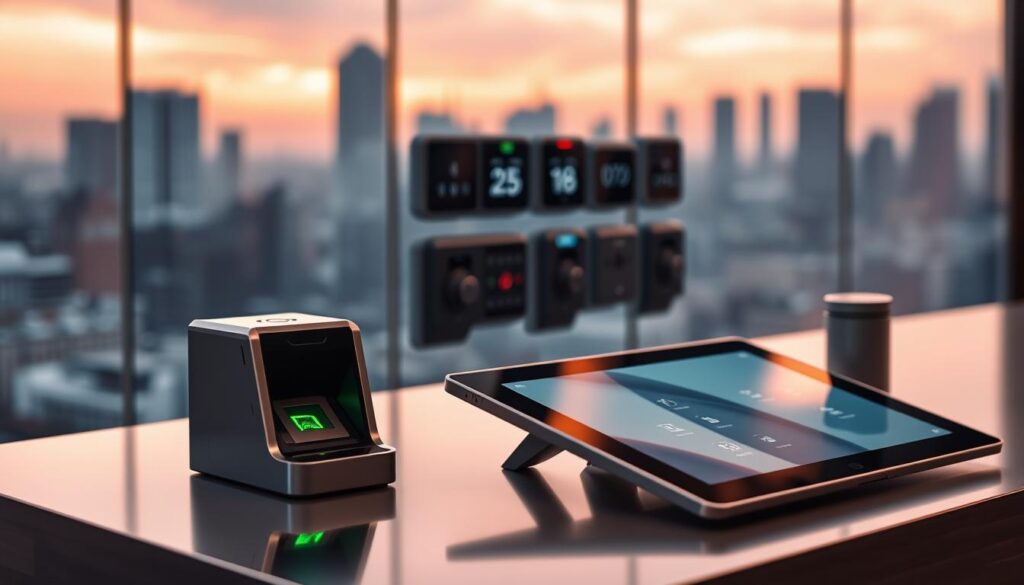
Fingerprint readers give strong identity checks and work well where users enrol once and throughput is moderate. They are cost-effective per device and suit offices and secure rooms.
Facial recognition terminals speed flow and are touchless, so they suit receptions and high‑throughput points. For high‑risk zones, multi‑biometric authentication (face + fingerprint) reduces false acceptance.
Standalone readers are affordable for a single door. Controller-based systems scale better across sites and integrate into a broader control system for central management.
| Environment | Recommended | Trade-off |
|---|---|---|
| Office reception | Facial recognition | Fast, higher cost |
| Warehouse turnstile | Card / fob | Durable, low enrolment |
| School gate | Keypad or card | Cheap, less identity certainty |
When privacy, gloves, dust or strong sunlight interfere, we recommend card, fob or keypad solutions. Cards are handy for visitor badges and temporary credentials without enrolling biometrics.
Look for anti‑spoofing, liveness detection, offline mode and audit trails when you compare products.
Hardware, door components and software that shape the final quote – Biometric Access Control Installation Prices
What you pick for readers, locks and licences will often decide whether a quote stays within budget or balloons.

Readers, controllers and access devices: what’s included and what’s extra
We normally see readers shipped with basic mounting, firmware and a short warranty. Controllers often include one or two door ports and core software connectors.
Extras usually add cost: extra enrolment stations, network configuration, reporting modules and integration drivers. Ask for model numbers and datasheets to avoid surprises.
Door hardware add-ons that change costs
Electric strikes commonly add about R1,200–R2,500 per door. Magnetic locks usually add R1,800–R3,000 per door.
Include exit buttons, REX sensors and mounting kits in your checklist to keep the final invoice sane.
Software licensing models that affect total cost
On‑prem, cloud and enterprise licences all shape ongoing spend. Choose the model that fits your scale and reporting requirements.
| Model | Initial licence | Ongoing |
|---|---|---|
| On‑prem (basic) | R2,000–R5,000 | R500–R1,000/year |
| Cloud setup | R3,000–R8,000 | R300–R700/month |
| Enterprise | R20,000–R50,000+ | R5,000–R12,000/year |
| Item | Typical range (VAT incl.) | Notes |
| Reader | R3,500–R15,000 | Depends on sensors & products |
| Controller | R4,000–R18,000 | Port count affects system scale |
| Electric strike | R1,200–R2,500 | Wood frame mounting kits extra |
| Magnetic lock | R1,800–R3,000 | Stronger hold, higher cost |
| Exit button / REX | R150–R900 | Safe egress components |
| Power supply / enclosure | R800–R4,000 | Depends on redundancy |
| Cabling & labour | R600–R2,500 | Long runs add time |
| What to confirm before sign‑off | Why it matters | |
| UPS / backup power | Keep doors operating during outages | |
| Network ports & switches | Needed for online systems and reporting | |
| Reporting needs | May require extra licence modules | |
| Who owns admin access | Clarifies support and future changes |
Buyer tip: We always ask for model numbers and datasheets. “Equivalent” swaps can alter warranty, servicing and long‑term costs — so confirm before you sign.
Installation complexity: wiring, retrofits and compliance considerations – Biometric Access Control Installation Prices
We find that site realities — from heritage finishes to long cable runs — change a straightforward job into a complex one.

Retrofitting older buildings and the real cost of additional wiring
Older properties often need new trunking, drilling through brick or metal and reworking frames. That extra work typically adds about R1,500–R3,000 per door in labour and materials.
Complex installs can also take 5–8 hours per door versus 2–3 hours for straightforward jobs. More time means higher labour and ongoing service effort.
Outdoor entry points, weatherproofing and long cable runs
Gates and perimeter doors need enclosures, surge protection and IP-rated devices to keep systems reliable in harsh weather.
Long cable runs often require extra switches, power distribution and protection, which raises both upfront costs and future maintenance.
Fail-safe vs fail-secure set-ups for operations and emergencies
Fail-safe locks unlock on power loss for safe egress. Fail-secure locks remain locked to preserve security.
We consider emergency procedures and local requirements when choosing behaviour for each door. The right pick reduces risk and avoids costly rework.
| Complexity adder | Typical impact on time | Estimated extra costs |
|---|---|---|
| No roof access / vertical runs | +2–4 hours | R800–R1,800 |
| Heritage finishes / special frames | +1–3 hours | R500–R2,000 |
| Long cable runs / extra switches | +1–3 hours | R600–R2,500 |
| Separate power / UPS needs | +1–2 hours | R1,000–R3,000 |
| Compliance item | Why it matters | Action to confirm |
| Emergency egress behaviour | Legal & safety | Specify fail-safe or fail-secure per door |
| Audit trails & logging | Incident response | Confirm software logging and retention |
| Power backup | Continuity of service | Include UPS for critical doors |
| Outdoor ratings | Device longevity | Choose IP-rated enclosures and surge protection |
Buyer tip: invest in tidy cable management and the correct lock type up front. That small extra spend saves time, service calls and higher costs later, and delivers a more reliable solution.
Budgeting by doors, users and sites – Biometric Access Control Installation Prices
Start small, plan for scale: per-door costs fall as shared system components are spread wider. That principle helps us budget sensibly for one door or dozens of points across branches.
How per-door costs change as you scale
Shared controllers, software licences and commissioning time are the main reasons per-door figures drop with scale. The first two doors carry the setup overhead; later doors only add hardware and short labour calls.
User volumes and admin workload
Enrolling users, managing leavers and issuing replacements take real time. Higher attendance and more users push up daily management effort, so factor admin hours into recurring costs.
Multi-branch reporting for time attendance
Central reporting matters for multi-site attendance tracking. Online systems reduce travel and manual reconciliations, but require reliable connectivity and the right software licences.
| System size | Per-door band | What’s driving the change | |
|---|---|---|---|
| 1–2 doors | R5,000–R8,000 | Setup overhead, controller & licence share | |
| 3–10 doors | R4,500–R7,000 | Better amortisation of software and labour | |
| 11–25 doors | R4,000–R6,000 | Bulk hardware pricing, central management | |
| 26+ doors | R3,500–R5,500 | Scaled purchase discounts and fewer per-door hours | |
| Rollout plan | Phase 1 | Phase 2 | Phase 3 |
| Doors | 1–3 | 4–15 | 16–30+ |
| Users | Up to 50 | 50–300 | 300+ |
| Reporting | Local logs | Central reports | Multi-branch dashboards |
Practical tip: standardise hardware, document door schedules and plan for future points so the system scales without costly rework.
Total cost of ownership in South Africa: ongoing fees and maintenance – Biometric Access Control Installation Prices
We explain the steady costs that follow purchase so you can budget for the life of the system.

Annual maintenance and what a service contract should cover
Annual maintenance commonly runs about 10–15% of the initial project value. For busy commercial sites this is often worth it.
A good service contract should include guaranteed response times, remote support, preventative checks, firmware and software updates, plus a clear replacements and warranty process.
Software renewals, licences and cloud subscription per door
Licence renewals typically add R2,000–R8,000 a year for on‑prem systems. Cloud subscriptions are usually quoted per door — expect roughly R150–R350 per month for basic plans and R300–R700 for premium packages with support.
Ongoing cost checklist
| Item | Frequency | Budget range |
|---|---|---|
| Planned maintenance | Annual | 10–15% of project |
| Licence / software renewals | Annual | R2,000–R8,000 |
| Cloud subscription (per door) | Monthly | R150–R700 |
| Spare parts / replacements | As required | R1,000–R5,000 |
| Ask before purchase | Cloud | On‑prem |
| Data ownership | Who holds live data? | Export & local control? |
| Offline operation | Failover options? | Works without internet? |
| Upgrade policy | Included updates? | Renewal costs? |
VAT note: recurring fees are often subject to VAT. Confirm whether subscriptions and annual renewals include VAT so finance teams can model true costs accurately.
We recommend planning for modular growth: adding time attendance, visitor modules or CCTV later will affect ongoing licence and service costs for your security solutions.
Biometric Access Control Installation Prices: Conclusion
Our final note focuses on the simple facts that make quotes comparable and predictable.
Summary: we find that across Gauteng the main drivers are door count, technology choice (fingerprint vs facial), wiring complexity and software needs. Start with doors and users, then validate site wiring and integration on-site to save time and surprises.
Fingerprints usually cost less per door than facial readers, but throughput and hygiene matter. Always compare like-for-like: confirm the access control system quote includes locks, cabling, licences, commissioning and VAT.
Next steps: list your doors, estimate users, note outdoor points and tell us preferred technology and location. We’ll scope accurately and help avoid hidden costs, with clear training and responsive support after handover.